
 US English
 UK English
 Português





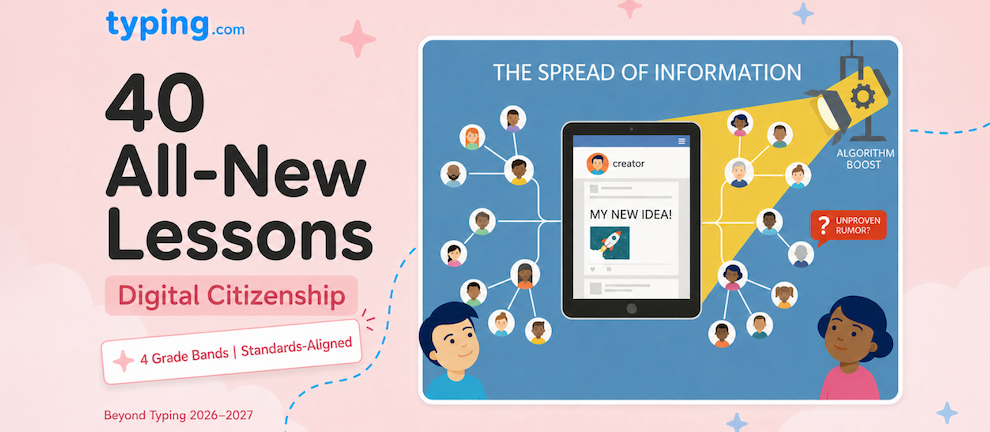
If you've been using our Digital Citizenship & Communication unit, you know it's tried to do a lot at once-citizenship topics like online kindness and privacy mixed in with broader tech literacy like passwords and surfing safety, all bundled together across grade levels. It worked, but it didn't go deep on any one thing.
We're changing that. The rebuilt Digital Citizenship unit is now laser-focused on what makes a good digital citizen and communicator, with 40 brand-new lessons scaled across four dedicated grade bands. The broader tech literacy content has moved out into its own dedicated unit called Technology Foundations, so each unit can finally go as deep as it needs to.
What's New?
The new Digital Citizenship unit is built from the ground up with four grade bands, each tuned to where students actually are developmentally:
K-2: The Foundations of Kindness and Trust
Our youngest learners start with the building blocks of being a good person online and off-kindness, empathy, respect, balance, and basic digital safety. We're not throwing the term "digital footprint" at a five-year-old; we're meeting them where they are with concepts they can actually internalize. Lessons cover things like how our words and actions affect others, why we keep certain information private, and how to balance screen time with everything else in our lives.
3-5: Identity, Footprints, and Healthy Relationships
By third grade, students are starting to navigate real online spaces. This band introduces digital footprint and identity, news and media literacy, online relationships, and what it means to be a respectful community member. Our digital footprint lesson uses the metaphor of walking through wet sand-every click, post, search, and message leaves a lasting trail-which gives students a concrete mental model they can carry with them for years.
6-8: The Hard Stuff
Middle schoolers are encountering the messier realities of online life: cyberbullying, digital drama, hate speech, privacy and security concerns, misinformation, and media manipulation. This band tackles all of it head-on with grade-appropriate depth. Students learn to spot misinformation, navigate online conflict, and protect their privacy in environments where social pressure is intense.
9-12: Career-Ready Digital Ethics
High schoolers go deep on the topics that'll follow them into college and the workplace: data privacy, layered security and encryption, propaganda detection, global collaboration, and career-ready digital ethics. Encryption isn't just hand-waved-it's actually explained. Propaganda detection covers the techniques used to manipulate audiences. And global collaboration prepares students for a world where their teammates and coworkers could be anywhere.
How Does It Work?
Every lesson follows a consistent rhythm: a themed video intro, an interactive activity, and a reflection that consolidates the learning.
The video intro is one of the biggest upgrades. Instead of text on a screen, each lesson opens with a fully-narrated video featuring the mentor and mentee characters from the student's chosen World (right now, Pixel Kingdom or Princess Adventures). The two characters walk through the lesson's concept in Socratic dialog - the mentee asks the kinds of questions a real student would ask, and the mentor answers in a way that's engaging and grade-appropriate. It's dramatically more compelling than a single narrator, and the research is clear that students retain more when they see concepts modeled through dialog like this.
After the video, students dive into the activity portion: quizzes, drag-and-drop exercises, scenario-based decision-making, "Type Your Own Adventure" branching scenarios, or other interactive work depending on the lesson.
Each lesson wraps with a reflection that asks students to apply what they've learned to their own lives-because digital citizenship only matters if students actually carry it with them.
Standards Alignment
All 40 lessons are aligned to ISTE 2 (Digital Citizen), plus a deep set of additional frameworks depending on the topic:
-
Common Sense Media strands - Privacy & Security, Digital Footprint & Identity, News & Media Literacy, Relationships & Communication, Cyberbullying / Digital Drama / Hate Speech
-
ISTE 3 (Knowledge Constructor), ISTE 6 (Creative Communicator), and ISTE 7 (Global Collaborator) where relevant
-
Career & College Readiness Standards for the older grades
Lessons also adhere to the relevant legal frameworks - CIPA, COPPA, FERPA, and GDPR - so teachers and administrators can be confident they're ticking the compliance boxes their schools and districts are required to.
How Does This Help You?
This rebuild means you can:
-
Teach citizenship without distraction. Tech literacy lives in its own unit now, so Digital Citizenship can focus entirely on the human side-respect, ethics, safety, communication
-
Hit the right depth for every grade. Four dedicated grade bands means a 2nd grader gets age-appropriate kindness lessons while a 10th grader is tackling propaganda and encryption
-
Meet the standards that matter. ISTE, Common Sense Media, and Career & College Readiness alignment across all 40 lessons, plus full adherence to CIPA, COPPA, FERPA, and GDPR
-
Engage students who tune out of text. Themed video intros with mentor/mentee Socratic dialog hold attention in a way static content can't
-
Send students home with real takeaways. The reflection portion of every lesson ties the concept back to students' own lives, which is where digital citizenship actually has to live
Where Can I Find It?
You'll find Digital Citizenship in your Curriculum section under Beyond Typing, in the group called "Beyond Typing 2026/27 PREVIEW." It's ready to browse, preview, and assign right now. Anything your students complete today carries over when these units become the standard Beyond Typing curriculum in July 2026.
Ready to Dive In?
Digital Citizenship is one of seven units being rebuilt for 2026-2027-check out the full summary of what's coming for the bigger picture. Or just jump straight into the preview section and start assigning. Your students will notice the difference from the very first lesson.