
 US English
 UK English
 Español





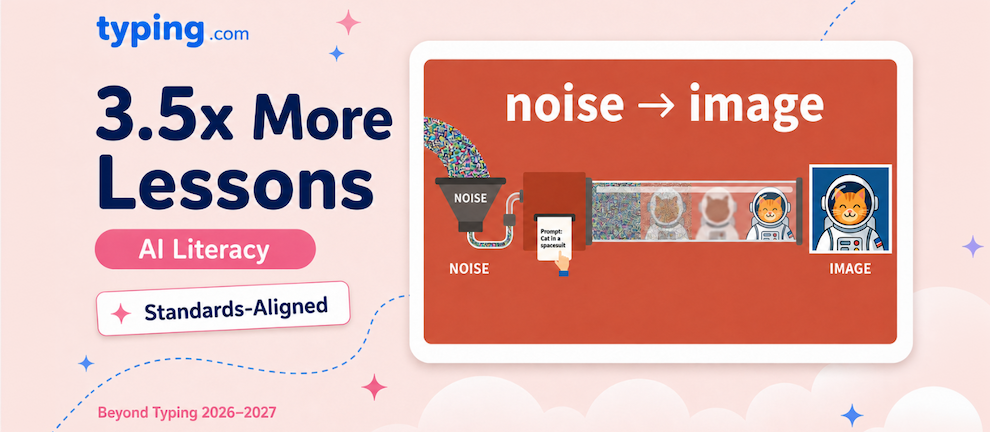
If you've used our existing AI lessons, you know we've covered the basics-one "What is AI?" lesson per grade band, one bias lesson, one prompt lesson. It was a solid starting point when AI literacy was a brand-new category. It's not enough anymore.
We're rebuilding it. The new AI Literacy unit is 3.5× larger than today's version, with 39 lessons spanning grades 3 through adult, full alignment to 8 major standards frameworks, and content depth that finally matches what AI literacy actually requires.
What's New?
The numbers tell the story:
-
Today: ~11 lessons total (3–4 per grade band, capped at grade 12)
-
Rebuilt: 39 lessons, with a brand-new Adult track so learners from grade 3 through adult education can build real AI fluency
Every lesson is built from multiple activities-video intros, quizzes, branching scenarios, prompt practice-not just a single screen. And the content goes way deeper than "What is AI?"
The 39 lessons are organized into five focus areas:
AI Foundations
The starting point. What is AI?, prompt engineering basics, and learning to use AI as a creative co-creator. Students develop the mental model they'll need for everything that follows.

How AI Works
The technical layer that's been missing. Machine learning basics, algorithms and decision-making, generative AI, neural network architectures (CNNs, RNNs, GANs), and how neural networks learn. Students don't just use AI-they understand what's actually happening when they do.
AI Ethics & Safety
This is where the rebuilt curriculum really earns its keep. Lessons include Using AI Responsibly, Spot the Bias, The Filter Bubble, Understanding AI Limitations, When AI Gets It Wrong, and The Ethics of AI: Three Perspectives. Students learn to recognize what AI gets right, what it gets wrong, and why.

AI in the Real World
The career and society layer. AI Systems and Society, AI at Work, AI City Planner, AI Policy Advisor, AI and the Law, AI Nature Explorer, AI and the Environment, AI and Career Futures, AI for Social Good. This is the content that helps students think about AI as something they'll actually encounter in the working world.

Transparency & Accountability
The capstone topics. Citing AI Resources, Building a Model Card, and AI Systems Analysis. Students learn the practices that responsible AI use requires-not just for school, but for professional contexts too.
A Note on AI Safety in the Curriculum
This is important: students do not have free, open-ended access to chat with AI tools during these lessons.
The AI prompt activities are guided and constrained-students practice prompt engineering within carefully designed lesson scenarios, with structured inputs and bounded outputs. There's no general-purpose chatbot window where students can ask AI anything they want. The experience stays focused, safe, and age-appropriate at every grade level.
This is by design. The point of AI literacy isn't to give students a chatbot; it's to teach them how AI actually works, where it falls short, and how to use it responsibly when they encounter it in the real world.
How Does It Work?
Each AI Literacy lesson opens with a themed video intro, followed by a series of interactive activities that put the concept into practice.
The video intro opens each lesson with a fully-narrated video featuring the mentor and mentee characters from the student's chosen World (right now, Pixel Kingdom or Princess Adventures). The two characters walk through the lesson's concept in Socratic dialog-the mentee asks the questions a real student would ask, and the mentor answers in a way that's engaging and grade-appropriate. For abstract AI concepts like neural networks or bias, that kind of modeled dialog is a far better way to introduce the idea than a static explainer.
After the video, students move into the activity portion. The unit uses four lesson formats, with Type Your Own Adventure and interactive AI prompt lessons:
-
Quizzes - multiple-choice knowledge checks with a written intro that frames the concept before the questions
-
Type Your Own Adventure (TYOA) - branching narrative scenarios where students make decisions and see how they play out. The format suits AI judgment, ethics, and decision-making content well, since students reason through a situation instead of just answering about it
-
Interactive AI prompt lessons - students build prompts by selecting from preset choices at each variable slot (no free-form text entry, so input stays on-topic). The lesson ends with an AI-generated image or short text response based on their selections, giving students hands-on prompt-engineering practice in a bounded environment
-
Standard typing - traditional typing practice with AI-themed source text

Standards Alignment
This is the biggest standards lift of any unit in the rebuild. All 39 lessons align to 8 major frameworks:
-
AI4K12 Five Big Ideas - the national K-12 AI framework
-
CSTA 2025 AI Learning Priorities - released in 2025
-
CSTA 2017 K-12 CS Standards
-
ISTE Student Standards (2023)
-
OECD/EC AI Literacy Framework - feeds the 2029 PISA assessment
-
State standards - California, Colorado, and North Carolina
-
Common Core ELA - 14 lessons with writing and source evaluation
-
NGSS - 16 science-adjacent lessons
If your state, district, or school has an AI literacy requirement, there's an extremely good chance this unit covers it. If they're about to have one (and many are), this unit is built for that too.
How Does This Help You?
This rebuild means you can:
-
Teach AI literacy with confidence. From machine learning basics to neural networks, ethics, and career impact-all in a safe, guided environment
-
Cover the depth your students need. 39 lessons across five focus areas instead of a handful of introductory ones
-
Reach learners at every level. Grade 3 through adult, with content scaled to where each student actually is
-
Meet emerging AI standards. All 39 lessons align to AI4K12, CSTA 2025, ISTE, OECD/EC, NGSS, Common Core ELA, and state standards for California, Colorado, and North Carolina
-
Keep students safe. Guided, constrained AI interactions-no open chatbot access, no free-form text entry into AI tools
-
Engage students with formats that work. Type Your Own Adventure scenarios and interactive AI prompt lessons with generated image outputs are some of our most popular content
Where Can I Find It?
You'll find AI Literacy in your Curriculum section under Beyond Typing, in the group called "Beyond Typing 2026/27 PREVIEW." It's ready to browse, preview, and assign right now. Anything your students complete today carries over when these units become the standard Beyond Typing curriculum in July 2026.

Ready to Dive In?
AI Literacy is one of seven units being rebuilt for 2026-2027-check out the full summary of what's coming for the bigger picture. Or jump straight into the preview section and start assigning. The first lesson will tell you more about how this unit feels than any description can.